
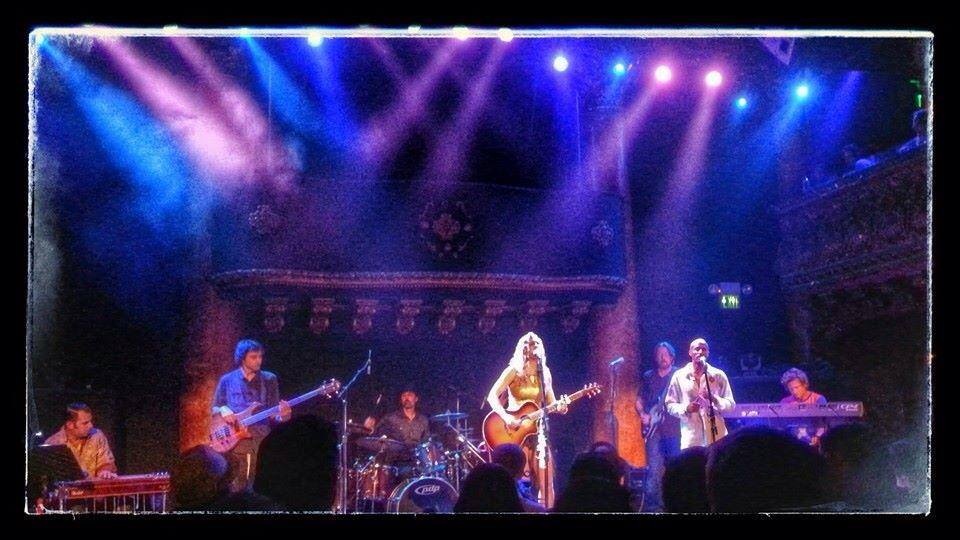
At first, a venue is practical. Where do I park? Where does the gear go? How much space does the drummer actually have? Is the room listening, eating, talking, dancing, drifting through, or some combination of all of it?
Some rooms become familiar because you play them once at the right moment. Others become familiar because you keep coming back. But after a while, a room becomes more than a room. It becomes part of the work.
Looking back, the rooms that stayed with me the most were not always the biggest stages or the loudest crowds. They were the places I returned to, sometimes with the same artist, sometimes with a different artist, and sometimes as a slightly different version of myself.
Rooms of Repetition
Playing a room again and again teaches you things a single show cannot. You learn the stage, of course. The load-in, the sound, the strange corner where a cymbal gets swallowed, the table that is somehow always too close to the hi-hat. But you also learn the room’s pace. And sometimes, when you play it enough, it helps unfold truths you never considered.
The following rooms represent a good portion of my gigging experience so far. While I have performed a great many songs in these rooms with numerous bands, it's not what I left patrons with that I'm reflecting on, but what the rooms gave me in return.
Le Colonial, San Francisco
When success seems imminent, but eludes you nonetheless
Le Colonial had a distinctive atmosphere. It was a French-Vietnamese restaurant in San Francisco’s Union Square District. Before it closed in 2024, it was famous for its 1920s French-colonial Vietnam aesthetic.
I organized a residency with the Sambosseros, a bossanova group based in Palo Alto from September 2009, to March 2010, and it was a glorious stretch. Not only did they pay us well, they fed us, and treated us like stars each Friday night for six months.
We would load in through the back door along the one-way Sutter just past Taylor, and snake our way through the kitchen to an exclusive-feeling club nestled above the cacophony of the diners noisily eating on the open floor below. We would set up along one side of the room to allow foot traffic to flow from downstairs to the bar.
Playing there felt like we were on a Casablanca-era movie set, with oversize rattan fans noiselessly spinning above. The first few gigs were exciting. I felt like I had made it. A paid weekly residency with a jazz band in a swanky, haute-couture restaurant in the city.
While we were a jazz band, we were a jam band at heart. We played traditional Bossa nova, but would let loose on solos and stretch songs out regularly. It was made for dancing and celebration. However, after the first few songs on our first gig, we were cautioned to turn down almost immediately. We already had a minimalist jazz setup: acoustic bass, guitar, jazz kit, kuhlohorn, and vocals. However, they needed it to be quieter.
Phew. Ok.
That's not really that uncommon on jazz gigs I suppose, but this felt restraining. We were in a noisy restaurant. How can we turn down AND be energetic to meet the bustle of the vibe?
The band never fully took off there, but it wasn't because we didn't belong or try. It felt like a match made in heaven, we just didn't have a local following at the time and it wasn't a natural draw for diners.
That was the lesson of Le Colonial. Sometimes a room can look like the exact place you are supposed to be, and still not become the thing you hoped it would.
Piacere, San Carlos
When the room asks you to find a different way to do the job
Piacere Restaurant had a distinctly different but equally vivacious atmosphere. It was a local Italian restaurant that had a bar and seating in front, and a semi-closed dining area directly behind the bar.
The band would always set up at the end of the open bar area, which was inconveniently situated in front of the main access to the outside dining. However, it was fine to be nestled in front of the patrons so closely. It felt intimate. Like we were in their living room. Servers would carefully tiptoe through the stage area to serve ice cold martinis and steaming hot plates of pasta.
The peculiar thing about this bar was that because it was so small, we could never start the night with loud music. The band I performed there the most with, Mark Bettencourt & the Aftermath, was a classic rock cover band, so the challenge was how to play classic rock covers, but quietly.
My first gig there I really had no idea what to expect. I generally tried to research the kind of setting I performed in so I would bring the right equipment. Not every gig requires the same kind or number of drums, cymbals, or sticks. I'm sure I would have brought my full kit to begin with, but what fit was a very modest four-piece: kit, snare, tom and floor tom. With a full-size kick drum (22-inch), I was crowding everyone and it was too loud.
What I learned that first gig was that if I played there again, I would need to bring a smaller kit. Luckily I had a combo kit with a 20" kick, 10" tom, and 14" floor tom. Over time I experimented with my 13" rack tom as a floor tom and that also worked well.
What I also came to understand was that I couldn't play with my sticks the first set. The owner would famously stand in the bar area during the first few songs and give direction to the bandleader with theatrical hand gestures to control the energy and volume. It was a constant battle. Every song on the first set for the first few gigs we would inescapably raise the volume and energy, and he would constantly be pushing our volume and energy down.
After a few gigs, I realized I just couldn't play that first set with sticks, but I would have to find an alternative. After trying everything in my stick bag, I finally landed on a solution that worked: using a muted brush in my left hand (half extended), and a backwards brush in my right. I would use the muted brush to keep the soft percussion on the snare, and then use the wire of the backward brush in my right on the hi-hat and cymbals so I would have the attack and shimmer of the brass, but not the volume.
It was restrained, but I could keep the energy of bigger rock songs without explosive volumes. At first I hated it, but then I realized it was just another challenge. How can you create pulse without percussion? It really wasn't different from the approach I had learned to take with bossanova. The music is soft, but energetic. You have to play with pace and punctuation, but not at high volumes. This setting was basically the same exercise, it just happened to be on classic rock.
Regardless, once the second set came on, and we were able to satisfy the owner enough, he would vanish into the back and presumably socialize with patrons, and I would switch to sticks. At that point all bets were off, and we would then hit the regular rock hits with reckless abandon.
Most nights eventually turned raucous, with people singing “Sweet Caroline” at the top of their lungs or banging their heads to “Highway to Hell.” But there were plenty of nights that never took off. Slow foot traffic. Holiday weekend. Too hot, and everyone was out of town. Too cold, and no one was going out.
Regardless, I learned a valuable lesson here: you have to constantly work to find the right way to play the music, and not use the same approach for every occasion.
Aloft Hotel, SFO
Playing to no one and everyone at once
Aloft Hotel SFO Airport was entirely different from most of the venues I performed in.
Aloft is a mixture of a club and a hotel, which is on brand. They market the chain as "music-inspired design hotels." This specific location is situated just south of the SFO airport, and is a perpetual waypoint for travelers and quick meetups. The lobby was equal parts stage, bar, front desk, and lounge. And it was none of them and all of them at once.
On the plus side, Aloft was an extremely easy load-in/load-out since you could pull your car up to the front door. The "stage" was steps from there. But because the space had so many uses, it was challenging to find the right energy. We were playing to "fan-toms" as I came to think of them.
I played there exclusively with a pop/reggae artist, Curt Yagi and the People Standing Behind Me, and we performed as a trio: acoustic guitar, electric bass, and drums. Playing Aloft felt like a long night because it's exhausting to play to a transient crowd. A handful of people staying for a few songs, but mostly we just play to travelers checking in, leaving, or just sitting down to check their phones. Occasionally people would tune in, but it always felt like a novelty.
Aloft taught me a different kind of discipline. Not how to command a room, but how to be present in one that was never fully yours.
Murphy's Law, Sunnyvale
Upping your game without changing it
Murphy’s Law was a place for rock and roll. Situated in downtown Sunnyvale on Murphy St, it felt like the town's cultural epicenter.
This bar's setup was unusual in that the drummer sat in the bay window at the front of the bar. The space was tight and uniform. Large bar on the right side, tables and chairs on the left. Large bay windows in the front and a back patio with covered tables, TV's, and an outdoor grill. I performed there over a nearly twenty year span before it closed in 2025.
This room taught me to be on display. I am a recluse by nature, which is odd because I'm a performing musician. But being in the store front at Murphy's, put a different pressure on me as a performer. How can I up my game without changing it?
Some nights I would try to be more emotive and expressive, and sometimes it would work. But sometimes it wouldn't and it would actually prevent me from nailing the end, or a key moment in the song.
Murphy’s Law taught me the difference between performing more and performing better and left me with a very important lesson: never let the theatrics detract from the musicianship. You're always on display, whether you think you are or not.
Pioneer Saloon, Woodside
Going to school onstage
Pioneer Saloon is one of the most important rooms of my musical career. I have played there many times with numerous artists and jams over the years.
Not only is it formative for my own musical maturation, but it is also an historic landmark in the area having been established in the late 19th century during the logging era. It still looks like it could belong in a logging town from the early 1900's with a modest wooden frame.
The entryway is dark and rustic, reminiscent of a log cabin. The stage is in the small bar in the back. It's big enough for a quartet, but takes up a good portion of the room. It has a short ceiling, mirrors on both walls, stained glass windows in the back, and a small door to a concrete patio. Its modest walls belie the history, community, and talent that have graced it.
Performing in that space so much, and with so many different acts, I found that it taught me about the difference between the acts more than anything else. It became a cornerstone of my performance architecture. Some bands did well there. Others withered. Some artists griped about the beer, the atmosphere, or the stage. Others worked the room as if it was their last gig.
During the blues jams at the Pioneer in the early 2010s, I witnessed performers from around the country, who have performed with legendary acts like Little Richard, Dr. John, Herbie Hancock, Ronnie Montrose and many more. I watched them step onstage humbly, and simply, focused only on the end product. No one complaining. No griping. Just doing everything in their power to deliver a peerless performance, no matter the song or accompanist. And when I had the chance to join them onstage, I was in school. Learning. Observing. Growing.
I learned the true meaning of a shuffle there. I learned that a drummer can be the star of the stage: leading a song from the throne, soloing on the rooftop, leaping over the kit, directing things from the back.
When I took that same stage with an individual act, I knew what was possible, and I knew it deserved reverence regardless of the artist or circumstance. And most importantly I learned that when I step onstage, I am an entertainer first, and a drummer second. My job is to lift people up, bring them somewhere else, and allow them to feel what I feel through the medium of sound.
The Pio, as many come to call it, has been a place of transformation for me. It taught me that the room does not have to be prestigious to deserve your full respect.
Club Fox, Redwood City
The ceremony of performance
Club Fox is an adjunct to the much larger, much grander 1,000-seat Fox Theatre in Redwood City, which was once part of the national Fox Theater network of the early 20th century. Those theaters are no longer related, but individually owned and operated. Marquee locations remain in Oakland, Atlanta, Detroit, and St. Louis.
In the larger venue in Redwood City, nationally touring acts perform, but in the much more modest 200-person Club Fox, local and regional acts can perform.
At one point in the early 2000s, this bar had become my local hangout, and my band at the time used to frequent there. The band was dying to perform there, and we constantly harassed management to give us a shot. They finally relented in the spring of 2005. We did everything to pack the place the first night and it went great. They gave us another night that summer which also went well.
Then we made the pitch. Let us perform at the NYE bash. They saw a positive track record, so they gave it to us: New Year's Eve, 2005. We opened up for the Unauthorized Rolling Stones. It was a huge deal. I was so nervous. I had never performed on such a big stage before and I don't think I had played such a big NYE gig either.
While I had seen numerous acts there, and understood the room, performing in it was altogether different. The stage is high, and there is a balcony that directly overlooks the band. You are absolutely the center of attention. It was awesome, but it was nerve-wracking.
We were a jam band, and our songs stretched and changed depending on the vibe and circumstance of the gig. I'm positive I rushed some songs from pure nerves.
After the gig though, I was able to say I performed there for NYE. It was a milestone for me and let me know that no venue was out of reach if I focused and tried.
Johnny Foley's, San Francisco
The work behind the music
Johnny Foley’s is a famously packed bar in San Francisco. It's reminiscent of Cheers, but SF-style.
Performing at Foley's was always fun, but you had to be able to respond to crowd requests. The bands that succeeded there were those that could whip out a song from nearly any genre on the spot. Sinatra? Ok. AC/DC? No problem. Carly Rae Jepsen? As you wish.
At Johnny Foley's I learned to learn on the fly. Most of the time I had no idea what we would be playing that night, but it didn't matter. They were paying me to play the music that was needed. This was always an exercise in listening, adapting, and entertaining.
But more than the performances at Foley's, this was one of the hardest load-ins I worked. At Foley’s, the gig started long before the first song. It started at the curb.
First of all, Johnny Foley's is uniquely situated between Union Square and The Tenderloin. That presents numerous challenges. With nearby shopping, hotels, and restaurants packed tightly, parking was non-existent.
Most nights I would have to double-park to load in. This was a careful dance because I might need to be there for a good 20-30 minutes, but also be on my toes in case a spot opens up.
To unlock the back door I would walk through the front door, through the kitchen, down a flight of stairs, and out to the back service entrance. I would prop the door open as little as possible to not attract unwanted attention. Expensive gear stacked inside of a door is a quick haul.
Unloading the car was the most sensitive part. I would have to quickly stage the equipment at the foot of the back stairway. Normally I would tackle it in micro trips: unlock the car, unload one movable set of gear, lock the car, haul the gear into the stairwell, and repeat.
Loading gear into the club was the hardest part though. I called it my free gym membership. I had to drag my four-piece kit with cymbals, stands, rug, and hardware up a flight and a half of stairs. I got it down to a science. With a 20-inch kick, I could make the trip in four hauls up the stairs, but with a 22-inch kick it would mean five. I quickly learned that less is more.
Once I got everything loaded into the venue, I would find a parking spot. If I was lucky someone would be leaving the block, but sometimes I would have to circle a few blocks. If I had to park on the Tenderloin side, I would give the nearest person on the street a few bucks to watch my car. It seemed to work luckily.
Once I got all the gear onstage, I would always start with the carpet. This taught me to be there first. If I got there late, guitarists and bassists would take up prime stage space and I would be cramped. It was easier to negotiate down in space than up. But once my carpet was down, I would start with kick, snare, hi-hat and throne. Once I had that combination down I would move on to toms, then stands, and finally cymbals. Bags and cases would either go into a spare room in the back, or if I was strapped for time I would pack them in the corner.
Breakdown and load-out was mostly the reverse of setup but less complicated because the bar and street were empty, and bartenders were barking last call.
Getting paid was the final step. You never leave without receiving or arranging for payment. Almost strictly in cash and in person, but things have changed with options like PayPal and Venmo. We would have to wait for the band leader to get paid, and then they would pay us. It was usually a waiting game: bartender or manager to bandleader, bandleader to band, and then a quick distribution of tips and pay together.
Foley's taught me that logistics, gear choice, and preparation are a major portion of what we get paid for.
A Room Has No Memory
Looking back, the most meaningful venues were not necessarily the obvious milestones. Some were, but others not. Regardless, they all gave something back in ways I did not truly understand until perspective revealed it.
These venues are part of the music because they shaped the musician I became. They gave my work a pattern.
The room remembers none of this.
But I do.