
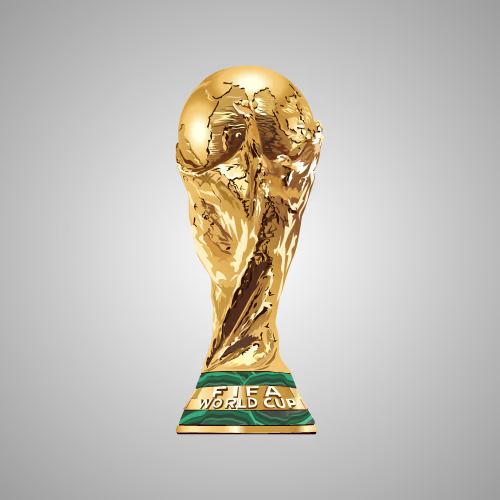
We Are Can Be the Champions
Most meaningful accomplishments begin as unreasonable ideas.
Before a company changes an industry, someone has to believe the industry can be changed. Before a movement gathers momentum, someone has to believe other people will join. Before a team wins a championship, someone has to imagine a future that does not yet exist.
We usually encounter these stories in reverse. We see the company after it succeeds, the movement after it grows, the champion after the trophy has been lifted. The outcome becomes so obvious that it is easy to forget how unlikely it once appeared.
What interests me is the period before success. The moment when a possibility exists, but only barely. When belief is scarce and the future lives mostly in the imagination.
Recently I found myself thinking about this while reading Mauricio Pochettino: “No one sees the USA as a contender. But why not?”
Why not, indeed?
The interview is ostensibly about the United States men's national soccer team and its prospects in the World Cup. But as I read it, I found myself thinking less about soccer and more about how groups of people come to believe in a shared future.
That's narrative. Community. Purpose.
Early in the interview, Pochettino addresses something many people associate with Americans: a confidence that sometimes borders on arrogance. He describes a country that decides to do something and assumes the outcome will eventually follow. Americans landed on the moon. Americans dominate many of their domestic sports. Why shouldn't they expect success in soccer too?
What interested me was that he didn't reject the instinct. He called it exciting. The challenge, as he saw it, was balance. The United States has never won a World Cup. It does not possess the history, tradition, or cultural relationship to the game that countries like Argentina, Brazil, Germany, or England enjoy. Pretending otherwise would be foolish. Yet Pochettino seemed equally uninterested in accepting that history should define the limits of possibility.
The more I sat with it, the less it sounded like arrogance and the more it sounded like belief.
I believe.
Later in the interview he contrasts Argentina and the United States through a simple observation. In Argentina, he says, a child's first gift is often a football. In the United States it may be a baseball, a basketball, or an American football. The comparison could easily have become an explanation for why the United States lags behind traditional soccer powers.
Instead, he moves in a different direction. There are hundreds of millions of people in the country, he argues. Tens of millions already possess deep cultural ties to the sport. There is room for soccer to grow alongside the sports Americans already love. The real problem, he suggests, is impatience. People want results now.
That observation triggered a memory.
In the summer of 1996 I played for the Central Coast Roadrunners, a newly formed semi-professional soccer team competing in the USISL, the lowest rung of the developmental ladder feeding into the newly launched Major League Soccer. We were a startup club. We had talented players, but so did plenty of other teams. There was no obvious reason to believe we would contend for a national championship.
After tryouts, and once the roster had been selected, our coach gathered us together so he could share something very important with us. He then proceded to produced a what I remember as a tiny whiteboard that said:
Central Coast Roadrunners
1996 USISL National Champions
We all sat with it for a minute, half wondering if it was a gag or if he was being genuine. When he didn't chuckle, and no one else blinked, be began to explain why he believed it.
We had the right players, the right circumstances, and the advantage of low expectations. Most people assumed a new club would be respectable. Few expected it to be competitive. And no one would expect it to genuinely compete for a national title.
That was the genius of this idea: its simplicity.
The speech lasted only a few minutes, but by the time we left the field the possibility felt real. Looking back, what strikes me is not that our coach believed we could become champions. Coaches say things like that all the time. What strikes me is that he convinced us to believe it too.
From that point forward, the championship became something more than a distant aspiration. It became a future state that all of us could see. Training sessions, road trips, and matches were no longer isolated events. They became part of a larger story that we had collectively decided might be true.
And in the end, we went on to win the national championship.
Our season eventually took us to Orlando, where we faced the San Francisco Bay Seals in the final. The Seals featured one of my former college teammates. I played marking back, a defensive position not typically associated with glory, yet I recorded the winning assist.
Go figure.
The details of the season have softened with time. What remains is the realization that the championship was not created in Orlando. It started months earlier on a practice field with a whiteboard and an idea that seemed slightly unreasonable at the time.
Pochettino describes the difference between playing and competing. At first it sounds obvious, but the more I thought about it, the more I realized he was describing something deeper. Playing is participation. Competing introduces consequence. Standards change. Decisions change. The future begins exerting influence on the present.
As the interview continues, another theme emerges. Pochettino discusses commitment. He references players who chose not to participate in the Gold Cup and his desire to build with the group that was present. What interested me was that he resisted making the discussion about any individual player. Instead, he seemed to be describing a principle.
Every group eventually reaches the same question: what does it mean to belong?
Belief creates energy. Possibility creates momentum. Eventually both require commitment. A team cannot function indefinitely as a collection of individuals making independent calculations. At some point, membership has to mean something larger than personal preference.
By this point in the interview, I had stopped thinking about soccer entirely.
I was thinking about companies, communities, bands, teams, and movements. Any group attempting to accomplish something larger than the individuals within it eventually encounters the same challenge. How do you get people with different motivations, experiences, skills, and perspectives to invest in the same future?
Near the end of the interview, Pochettino speaks about football as a unifying force. Not because it eliminates disagreement, but because it creates shared purpose. People remain different. They retain different experiences, values, opinions, and identities. Yet for a moment they can move in the same direction.
I kept coming back to that idea.
A football team does not require identical players. A company does not require identical employees. A community does not require identical members. In fact, the differences often represent its strength. Different skills, different backgrounds, and different perspectives create depth. The challenge is helping people see the same horizon long enough to move toward it together.
Perhaps that is why the interview stayed with me.
On its surface, it is about whether the United States can win a World Cup. Underneath it is a meditation on how people organize themselves around futures that do not yet exist.
Near the end, Pochettino returns to the language of dreams. He says he never had an American dream. He had an Argentinian dream, a Spanish dream, and an English dream. The American dream, as he describes it, is simply the belief that anything is possible. Not because it is likely, but because it remains possible.
That observation brought me back to the title of this essay.
For many Americans, the instinct is to begin with "We Are the Champions." We expect to contend. We expect to win. Sometimes we assume the outcome before the work has begun. It is the same instinct Pochettino was describing earlier in the interview when he spoke about American confidence and ambition.
What struck me was that he never argues for abandoning that instinct. If anything, he seems intent on preserving it. He simply edits it.
Not "we are." but "we can be."
The difference is small enough to fit inside a title and large enough to reshape an entire mindset. One assumes the outcome has already been earned. The other acknowledges the distance between where we are and where we hope to go. One is arrogance and hubris. The other is hopeful determination and optimism.
The United States is not entitled to a World Cup because it is wealthy, ambitious, or accustomed to winning other sports. Soccer does not work that way. It is peformed on the pitch, in realtime. The trophy belongs to no one. You must earn it.
Every. Single. Moment.
Yet Pochettino is not arguing against American confidence. He seems to understand that the belief that difficult things are possible is one of the country's defining characteristics. The challenge is not eliminating that instinct. The challenge is directing it toward something useful.
The Roadrunners were not champions when our coach wrote those words on the whiteboard.
The United States is not a world champion because Mauricio Pochettino says it can become one.
In both cases, the future remained uncertain. But uncertainty is not the same thing as impossibility. Belief does not guarantee an outcome. What it does is keep a possibility alive long enough for people to organize themselves around it.
We spend a lot of time studying talent, strategy, resources, and execution. We spend less time studying the conditions that allow those things to align. Yet alignment may be the force multiplier hiding beneath all of them.
Looking back, that may be what our coach understood when he wrote "1996 USISL National Champions" on a whiteboard. It may be what Pochettino is trying to cultivate now: a team, a crowd, and perhaps even a country orienting themselves toward the same possibility.
I have come to think of that kind of alignment as coherence. Not because everyone agrees. Because they have found a direction worth pursuing together.
Sometimes that's where championships begin.