
When the 2026 FIFA™ World Cup kicked off, I thought I was building a tournament tracker.
By the end of the tournament, I realized I had built something much bigger.
Like many soccer fans, I wanted a better way to follow the tournament. I wanted standings, knockout projections, Golden Boot races, team information, schedules, and enough context to understand what every result actually meant. As the tournament unfolded, new ideas kept appearing almost daily, and the site evolved right alongside it.
Some of the biggest challenges weren't obvious at first. FIFA's new 48-team format introduced one of the most complicated tournament structures the World Cup has ever used. Twelve third-place teams competed for only eight knockout-round spots, with their placement determined by dozens of predefined permutations hidden away in Annex C of the tournament regulations. Solving that puzzle became one of the most satisfying parts of the project.
The projection engine eventually grew into something that could forecast the entire tournament from the group stage all the way through the Final, updating as every match was played. After the tournament concluded, I added a performance scorecard so visitors could see exactly how those projections compared with what actually happened.
But the tracker became more than a prediction engine.
Hundreds of fans visited throughout the tournament. Friends shared it. Soccer communities linked to it. Conversations sprang up around matches, scenarios, and possibilities. It became a place to explore the tournament rather than simply check scores.
Now that the 2026 Men's World Cup has concluded, the tracker enters its next phase.
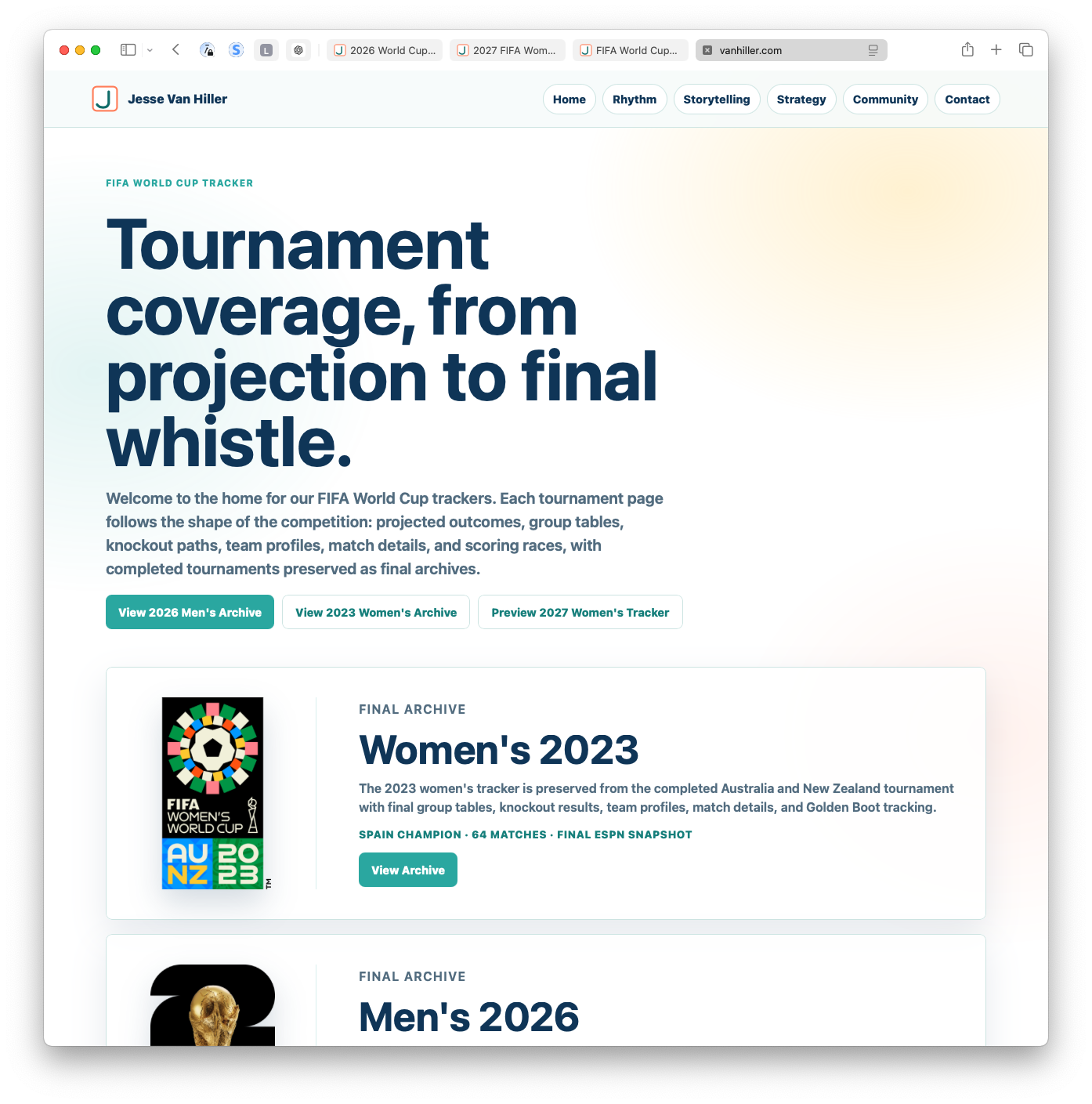
Rather than disappear, the entire tournament has been preserved as a permanent historical archive. Every page remains available exactly as it existed during the competition, capturing one of the most significant tournaments in FIFA history—the first men's World Cup featuring 48 nations.
Meanwhile, the main World Cup Tracker page is becoming the front door for every tournament. Over time it will grow into a collection of men's and women's World Cups, each preserved as its own historical snapshot while new tournaments are added.
The next stop is already on the calendar.
The 2027 FIFA™ Women's World Cup.
The framework is in place. The lessons from 2026 have been learned. The foundation is much stronger than it was on day one.
The final whistle on one tournament simply marks the kickoff of the next.
See you in Brazil.